


BECEP.
An awareness campaign created to improve road traffic safety

BECEP.
An awareness campaign created to improve road traffic safety
Campaign results
1.5+ million
300K+
23 360+
4 755+
365-day safe driving campaign

About the client
BECEP (short for Road Traffic Safety) is a dedicated department of the Ministry of Transport of the Slovak Republic and the national coordinator for improving road traffic safety in Slovakia. It’s behind the National Road Safety Strategy approved by the Slovak government, and it communicates safety topics across all groups of road users – from children and seniors, to cyclists and motorcyclists, to professional drivers.
For BECEP, this isn’t about selling a product or running a one-off campaign. Its goal is to reduce the number of deaths and serious injuries on Slovak roads by 50% by 2030 – and ultimately reach zero road traffic fatalities (Vision Zero). That’s why, from the start, one goal was essential for us: moving the topic of safety from a poster into the real-life decisions of every road user.
The story of our collaboration
BECEP reached out to us with a request to take part in a public tender for running an entire year-long awareness campaign. This wasn’t a typical agency outreach – it was an open competition that multiple agencies could enter at once. The context was clear: BECEP hadn’t run any major public-facing campaign aimed at the general population since 2008. This campaign was meant to change that.
The brief was specific: prepare a script for the first framework theme of the campaign, focused on drunk driving. The winner would receive the contract for the entire year-long campaign across all four themes. We entered, prepared the script, submitted it, and won the tender among several competing agencies.
Before launching the first campaigns, we went through the full scope of the collaboration with them – four framework themes, a 12-month schedule, and a communication mix covering social media, video content, native advertising, and radio spots. Only after the entire plan was approved did we launch the first campaigns.
HOW IT STARTED
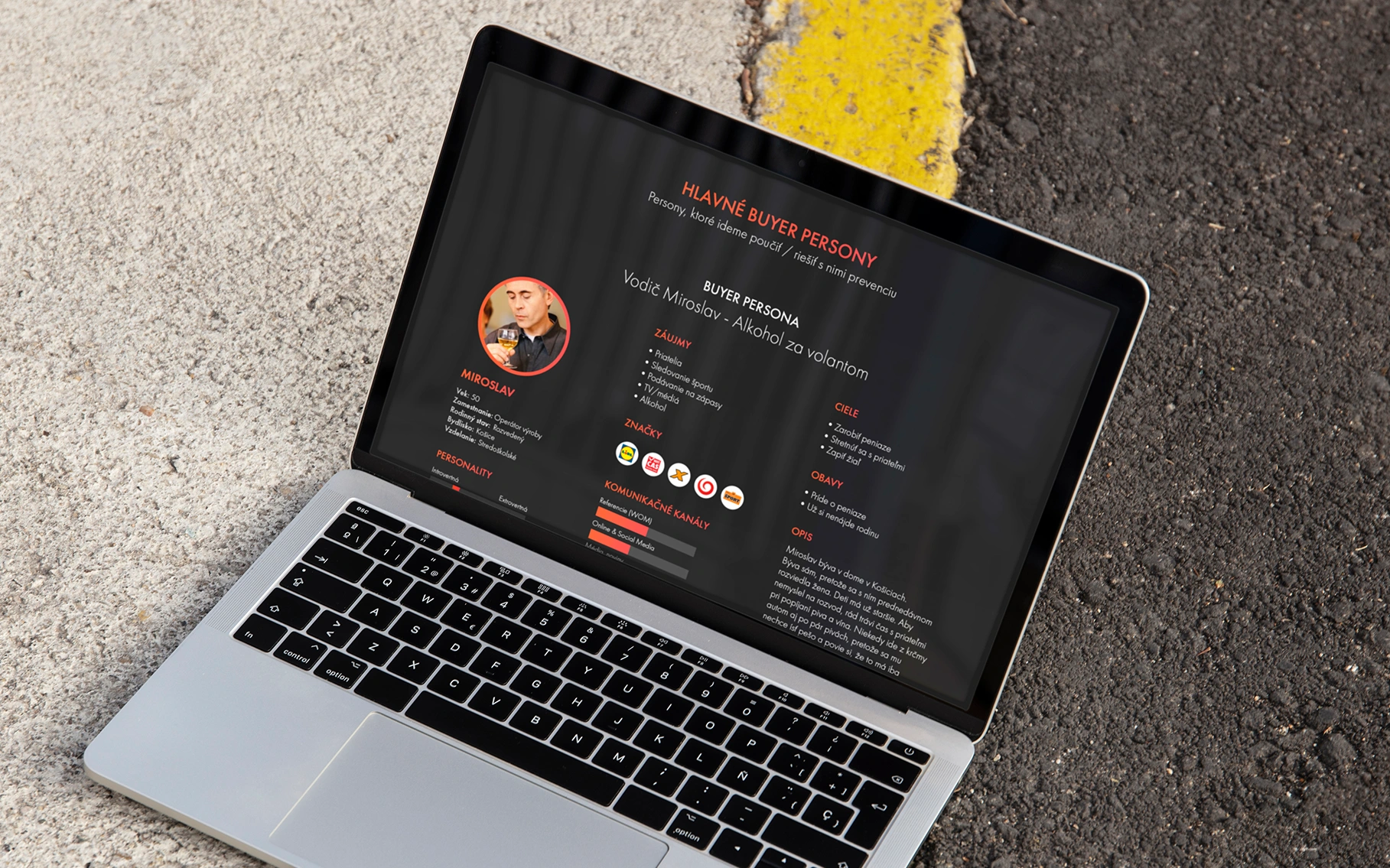
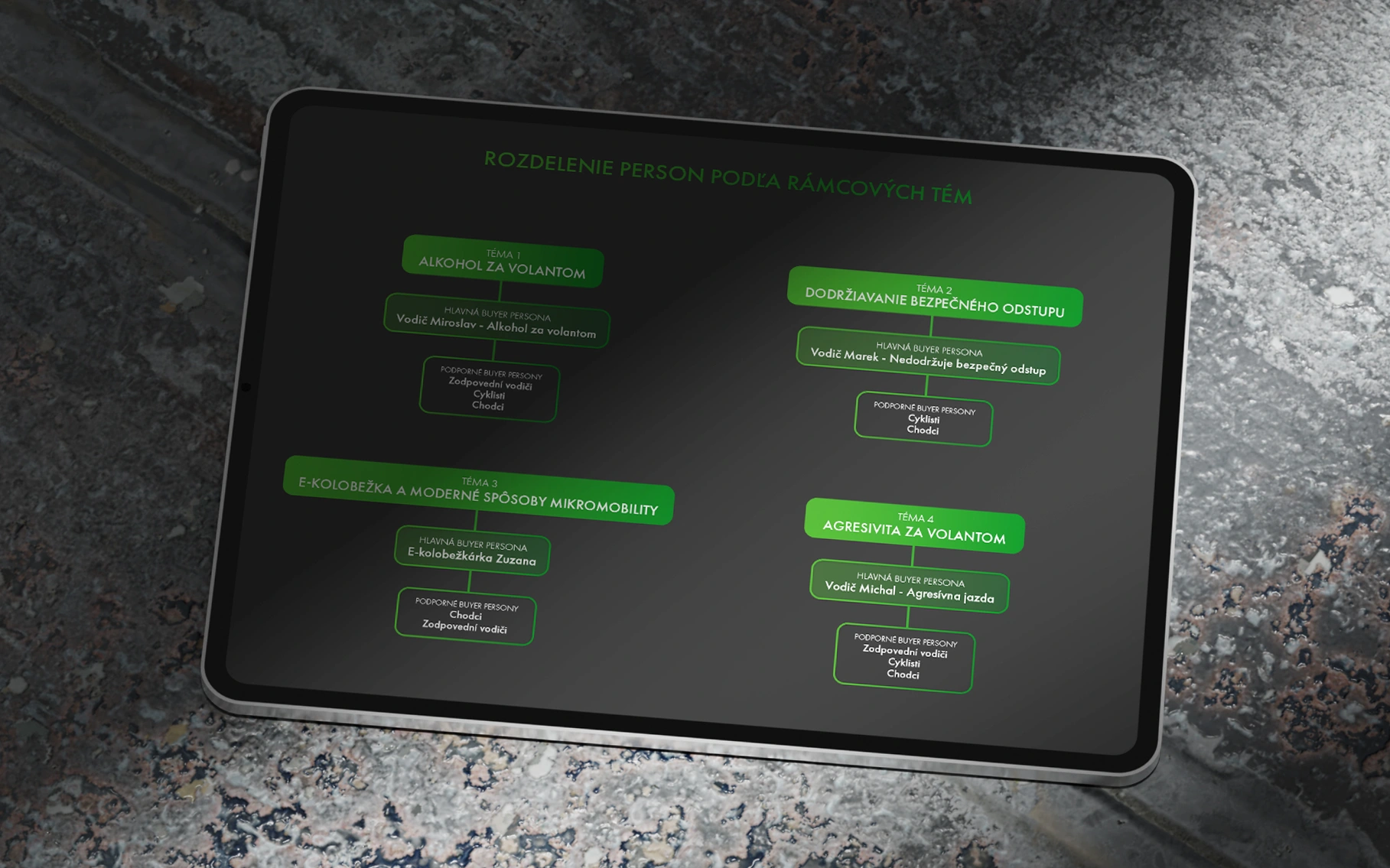
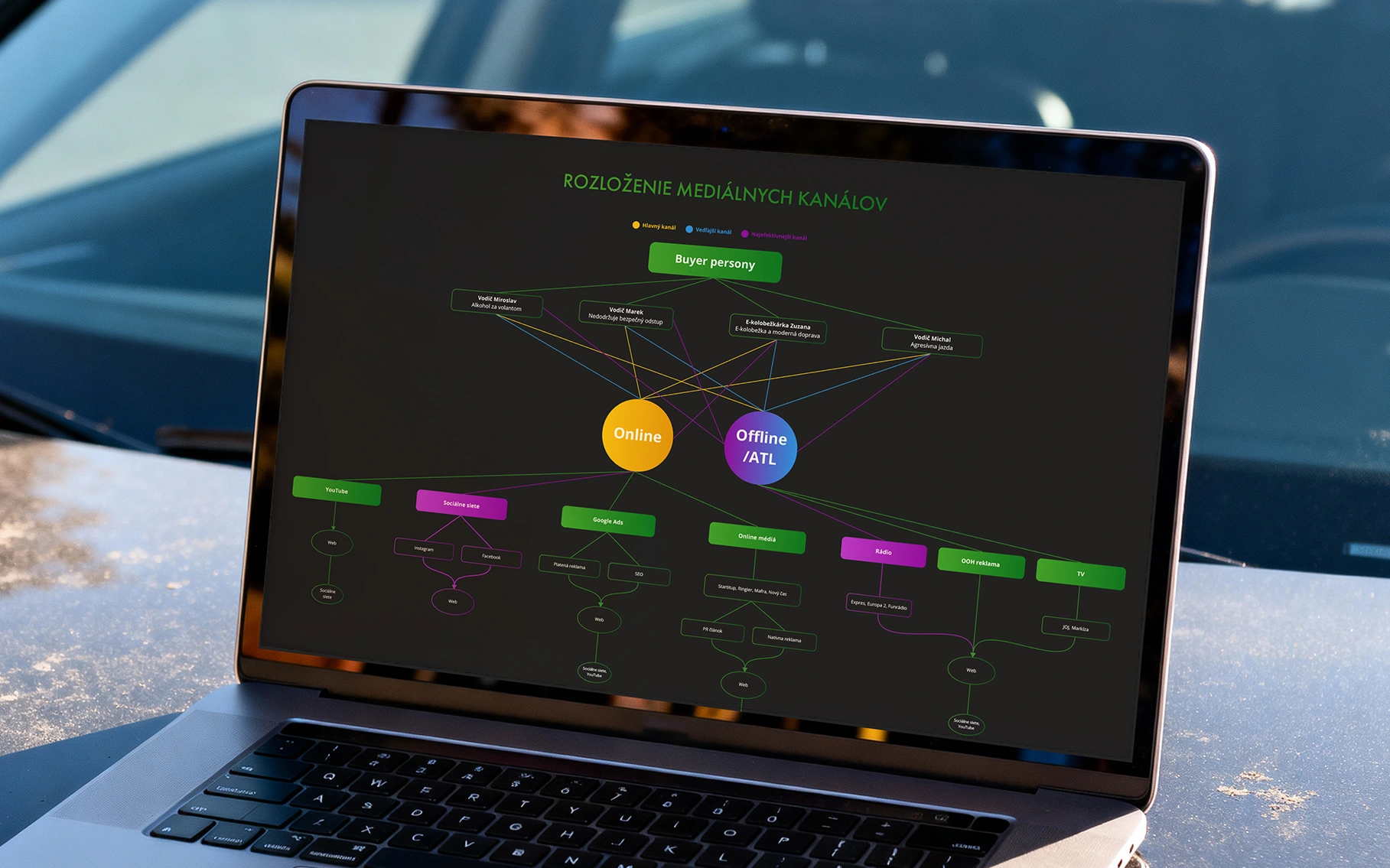
We didn’t start straight with campaigns, but with analysis and strategy. As part of Insight & Strategy, we prepared a keyword analysis, SWOT analysis, and target audience analysis – including their social media behavior and media habits. Based on this, we defined buyer personas for the individual at-risk groups of road users and mapped them onto the four framework themes of the campaign, including the exact channel mix for each one.
The analysis showed that BECEP’s target audience is essentially all of Slovakia – everyone is a road user, whether as a driver, a cyclist, or a pedestrian. That’s why we didn’t opt for narrow targeting, but rather a communication mix capable of reaching different groups on the platforms where they actually spend time.
For each theme, we built a three-month schedule, gradually sparking interest in the topic, showing its consequences, and finally communicating prevention. We submitted the whole plan to BECEP, and once approved, we launched the first campaigns. Below, you’ll see how we turned this strategy into real results.
What we did
Over twelve months of collaboration, we built a campaign for BECEP around four framework themes. This wasn’t about one-off ads, but about a connected communication system spanning multiple channels at once – paid advertising on Facebook and Instagram, video content on YouTube, native advertising via Google Ads, and radio spots on stations like Rádio Expres and Europa 2. Within each three-month schedule, every channel had its own role, and they complemented each other so we could reach the same person multiple times – in different places and at different stages of the topic.
Facebook and Instagram
Facebook was the main platform throughout the campaign – achieving significantly higher organic reach, more comments, and more interactions than Instagram. We used Instagram in parallel, but with a smaller budget, since the data consistently showed that Facebook delivered better results for this type of content.
Each framework theme ran for three months, and we deliberately varied the content throughout. First, through polls, questions, and thought-provoking posts, we sparked interest and prompted people to reflect on their own behavior. In the second month came video content showing real consequences – videos consistently achieved the highest reach. In the third month, we focused on education and prevention, also directing people to BECEP’s website.
Over 12 months of the campaign, Facebook reached over 645,000 people, and Instagram over 364,000. Since Meta attributes the same person to multiple campaigns, these two numbers can’t simply be added up into an exact count of unique people across both platforms.
The posts generated almost 23,000 reactions and over 4,700 comments. Genuine discussions sprang up under most posts – people shared their own experiences related to drunk driving, aggressive drivers, and dangerous scooter riding. The strongest response came around the topic of aggression, where some posts collected hundreds of comments within just a few hours.
Boosted video content for each theme was watched by over 119,000 people. A parallel community growth campaign also ran alongside it, which significantly grew BECEP’s Facebook page during the campaign.
Learn more about our Meta Ads campaigns.

YouTube and Google Ads
We used YouTube for video content of all lengths – from short animations and Shorts to full-length key visual videos tied to each framework theme. Right from the start, it became clear that short formats (Shorts) performed significantly better in organic reach than longer videos, since they’re consumed quickly and the YouTube algorithm recommends them more effectively.
Just like on Meta, we varied the content based on the stage of each theme. In the first month, we published animations and short videos to spark interest. In the second month came the main key visual video with the strongest emotional impact – these videos also received the most promotion, since their job was to show the real consequences of risky behavior. In the third month, we shifted the content toward education and prevention.
Over 12 months of the campaign, the published videos were watched by over 161,000 people. The strongest month was June 2024, during the Micromobility theme, when the key visual video alone gathered almost 46,000 views – the highest monthly result of the entire campaign up to that point.
We deployed native advertising via Google Ads at the end of each framework theme – in its third month, during the prevention phase. The banners directed people straight to BECEP’s website, where they could read more about the topic. We placed them on motoring and news websites, where our target audience analysis showed the relevant audience could be found.
The four native campaigns (one for each theme) achieved a combined total of over 889,000 impressions and generated 777 clicks through to the website.
Learn more about our YouTube and Google Ads campaigns.
Framework themes
Instead of one general road-safety campaign, we split the content into four specific risk areas – drunk driving, keeping a safe distance, micromobility, and aggressive driving. The choice of themes wasn’t arbitrary – it was based on keyword analysis and target audience behavior, which showed where people’s interest was highest and where awareness efforts made the most sense. Each theme targets a different group of road users and addresses a distinct problem, making the communication far more targeted than a single general message for everyone.
Each framework theme followed the same three-month schedule:
Month 1 – we sparked interest in the topic
Month 2 – we showed the real consequences through video content
Month 3 – we focused on prevention and solutions
This allowed us to build on the same theme over time, instead of relying on one-off communication that quickly fades away.
Below, you’ll find a detailed breakdown of the results and creatives for each of the four themes.
1. Drunk driving
The first theme addressed one of the most underestimated risks on the road – driving a short distance after drinking. The target audience was mainly drivers who get behind the wheel after a beer or a glass of wine, convinced that “it’s only a few kilometers” and nothing will happen. Through facts, polls, and video content, the campaign showed how quickly alcohol actually leaves the body and what consequences a decision like that can have.
2. Safe distance from cyclists and pedestrians
The second theme focused on drivers who don’t keep a safe lateral distance when overtaking or passing cyclists and pedestrians. These are often drivers who are in a hurry and see a cyclist as an obstacle on the road rather than a vulnerable road user. The campaign reminded them of the legally required distance of 1 to 1.5 meters and showed how serious the consequences of even a seemingly small mistake while overtaking can be.
3. E-scooters and micromobility
The third theme addressed the growing phenomenon of electric micromobility – especially e-scooters, which have become a common part of urban transport, though their users often don’t know the rules for moving on roads and sidewalks. The campaign targeted not only the riders themselves, but also car drivers, who need to know how to safely coexist with these new road users. The core topics were riding on sidewalks, speed, behavior at crossings, and mutual respect on the road.
4. Aggressive driving
The fourth and final theme dealt with aggressive behavior behind the wheel – overtaking on a solid line, honking, flashing headlights, dangerously braking in front of another driver. The goal was to show that aggression on the road isn’t just a matter of personality, but a real threat to lives. The campaign reached drivers who encounter aggressive situations every day – not just those who cause them, but also those who experience them as victims. Of all four framework themes, this one sparked the biggest response in the comments – people spontaneously shared their own unpleasant experiences on the road.
Solution
Part of the preparation was also a creative concept, meant to set the visual direction for the entire campaign across all four framework themes – a visual language that would be instantly recognizable and consistent throughout the year.
We decided to lean into emotion. For content communicating negative topics, we chose black-and-white photography with bold text and a contrasting red color. For positive, educational content, we instead used color photography with green text – BECEP’s own brand color. In every visual, we creatively incorporated the logo, subtly emerging from a white frame. This way, people could never mistake BECEP’s content for anyone else’s.
For the videos, which formed the key visual for each framework theme, we came up with a concept built around the absence of main characters – we talk about people, but never actually show them on screen. The reason is always the same: they became a victim of a driver under the influence of alcohol, caused a serious accident by failing to keep a safe distance, or are bearing the consequences of their own behavior behind the wheel. This absence is more powerful than any direct depiction.
The videos were also paired with radio spots that mirrored their content and themes. The voice-overs for both the videos and the radio spots were recorded by our long-time collaborator Peter Bažík, whose voice always managed to capture the exact atmosphere of each video or spot.


Alongside the videos and radio spots, each month we created and published posts on Facebook, Instagram, and YouTube according to pre-prepared content calendars. We adapted shorter video content into YouTube Shorts format, regularly published blog articles directly on BECEP’s website, and prepared native advertising for each theme, placed on sites where the current target audience spent time.
In the first month of each framework theme, we deliberately used more controversial and provocative questions – through polls and direct questions, we prompted people to reflect on their own behavior on the road. Some responded surprisingly openly, others strongly disagreed. We welcomed both reactions. Since customer care was also part of our work, we actively monitored the comments and stepped in to moderate when needed.
The logic behind this was simple: the people who engaged in the discussion in the first month – whether they agreed, disagreed, or just followed along – became exactly the audience we needed to reach in the second and third months. To show them the consequences. To educate them. And ultimately, to move them from awareness of the problem toward real behavior change on the road.
Results of the framework themes
1st framework theme - Alcohol
Over 330 thousand
Almost 80 thousand
We gained 4,545
reactions/likes
people wrote us 942
comments

Video - Key visual
Radio spots
2nd framework theme - Safe distance
Over 380 thousand
Over 83 thousand
We gained 4,076
reactions/likes
people wrote us 1,374
comments
Video - Key visual
Radio spots
3rd framework theme - Micromobility
Almost 490 thousand
people reached
Over 77 thousand
We gained 4,659
reactions/likes
people wrote us 882
comments

Video - Key visual
Radio spots
4th framework theme - Aggression
Almost 290K
Over 64 thousand
We gained 10,022
reactions/likes
people wrote us 1,547
comments

Video - Key visual
Radio spots
Conclusion
Over 12 months of collaboration, we built a comprehensive awareness campaign for BECEP across four road safety risk themes. Together, we reached over 1.5 million people, sparked more than 23,000 reactions, and got a genuine conversation going on topics that affect every road user.
These results, however, don’t rest on the ads alone. They rest on how we’ve approached the collaboration from the start – as a long-term partnership, not a series of campaigns. That’s exactly our DNA.
Our DNA
Because results are built on how the collaboration is set up from the start – not on a one-off campaign, but on a system that makes sense long-term:
Not just a trial run
We set up collaborations to make sense long-term, not just for a few months. Marketing needs time to get going and deliver measurable results – exactly what we saw with BECEP, where the strongest response only came after systematic work across all four framework themes.
We cover the start
With a long-term collaboration, you get initial activities worth up to €3,000 for free and a 50% discount on the first 3 months. We believe in projects enough to provide the first key steps – setup, analyses, and strategy – free of charge, so you get a quality start without having to pay for every first step.
Experience, not experiments
A senior team with a clear goal – results, not testing – works on your project. Thanks to experience from projects like the BECEP campaign, we know exactly where to start and what can work right from the first month.

kon takt.
Kickstart long-term effective marketing. Get up to €3,000 and a 50% discount on the first 3 months to start.
Want similar results? Write to us and we’ll get back to you within 24 hours.